Spray Foam Proportioner Buying Guide: How to Choose the Right Machine
A spray foam proportioner is one of the most important investments a contractor makes. The machine you choose affects daily production, chemical delivery, troubleshooting, and your ability to document how a job was performed.
Comparing equipment requires more than looking at maximum pressure, output, and purchase price. You also need to understand how the machine moves material, measures chemical flow, manages temperature, and responds when conditions change.
Whether you are considering the Akurate Dynamics Pro-X, the Delta CPS-HV, or another proportioner, these are the questions that deserve attention before you buy.
Start With the Work You Actually Do
Choose equipment around your applications and operating conditions. Consider the chemicals you spray, typical job size, required output, hose length, available electrical power, and the temperatures your rig encounters.
A machine’s maximum output does not tell you how it will perform with cold incoming material or during extended spraying. Ask whether the complete system can maintain the chemical manufacturer’s required processing conditions at your intended production rate.
Akurate Dynamics identifies the Pro-X as a particularly good fit for wall foam applications. Contractors comparing it with the Delta CPS-HV should request an application-specific recommendation and current specifications for both machines. Confirm output, heating capacity, electrical requirements, and hose configuration against the work your business performs.
Understand Why Pump Technology Matters
The pump is the foundation of chemical delivery. Its design influences how material moves through the system and how delivery responds to changing conditions.
Piston pumps, used in spray foam proportioning equipment since the 1960s, rely on a back-and-forth motion that can introduce pressure fluctuations and pulsation. As today’s A- and B-side chemical formulations continue to evolve, these characteristics can present challenges to consistent chemical delivery.
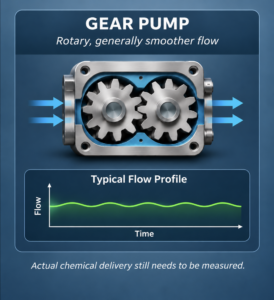
Gear pumps are rotary positive displacement pumps. As their gears rotate, they carry chemical from the inlet to the outlet in successive volumes. This rotary action can provide relatively smooth delivery with low pulsation. Pump speed also provides a practical way to regulate output.
For spray foam contractors, this makes gear pump technology worth examining closely. Consistent chemical delivery provides a useful foundation for proportioning, but the pump must work together with appropriate measurement and control.
Ask the equipment manufacturer to explain how the system determines actual delivery on each chemical side—and how it responds when those deliveries differ.
Laminar Flow: What It Means for Spray Foam Chemicals
Laminar flow is the smooth, orderly movement of a liquid through a passage, with minimal turbulence. Whether flow is laminar depends on the relationship among viscosity, velocity, density, and passage diameter, commonly expressed through the Reynolds number. More viscous liquids tend toward laminar flow under otherwise comparable conditions.
This matters when evaluating how spray foam chemicals travel through separate A-side and B-side delivery paths. Their viscosities and temperatures influence flow behavior and the resistance the system must overcome.
However, smooth delivery and laminar flow describe different characteristics. Smooth delivery concerns how much flow fluctuates over time. Laminar flow concerns the way fluid moves within a passage.
A gear pump can help reduce delivery pulsation, but pump type alone does not establish that flow remains laminar throughout a proportioner and hose assembly. The reciprocating action of a piston pump can introduce flow disturbances that, under certain operating conditions, contribute to turbulence.
For buyers, the useful question is: How does the complete system maintain stable, measurable chemical delivery across its operating range?
Why Flow Meters Complete the Picture
Gear pumps move chemical. Flow meters measure delivery.
This distinction matters because theoretical pump displacement and actual delivered volume can differ. Internal leakage, commonly called slip, affects rotary positive displacement pump capacity. A controller therefore benefits from feedback about what is actually flowing rather than relying solely on commanded pump speed.
Flow meter selection and calibration must account for the fluid and its operating characteristics, including viscosity and flow profile.
When suitable meters are integrated with independently controlled gear pumps, their readings can support a feedback loop: measure delivery, compare it with the target, and adjust pump operation.
Akurate’s Pro-X and Delta CPS product information describes this approach: integrated software adjusts motor speed using high-resolution flow meter data to control the A-to-B delivery ratio.
The buying question becomes more specific: Does the machine display flow, record flow, or use measured flow to actively control proportioning?
Evaluate Temperature Control Alongside Ratio Control
Temperature changes chemical viscosity, which affects how material moves through the system. Heating performance therefore deserves the same attention as pump capacity.
Ask how the proportioner handles incoming chemical temperature, sustained production, and heat loss along the hose. Determine whether A-side and B-side temperatures can be managed independently and where the system measures them.
Also ask what happens when the selected temperature cannot be maintained. A setpoint tells you what the operator requested; a measured temperature helps show what the system achieved.
Always evaluate these capabilities against the chemical manufacturer’s processing requirements.
Compare Measurement, Control, and Documentation
A digital screen can make equipment easier to operate, but buyers should examine what happens behind the display.
Use these questions to compare systems:
| Buying criterion | What to ask |
|---|---|
| Chemical delivery | How is actual A-side and B-side flow measured? |
| Ratio control | Does measured flow drive automatic adjustments? |
| Protective response | What triggers an alarm or shutdown, and how quickly? |
| Temperature management | Where are temperatures measured, and can each side be controlled independently? |
| Job records | What information is retained, and how are interruptions or deviations shown? |
| Technical support | Can technicians review operating conditions during a problem? |
| Ownership costs | What maintenance, software, reporting, and service costs apply? |
Request a demonstration that includes starting, stopping, and changing output. Ask the supplier to show how the machine responds and what appears in the resulting job record.
Buy for the Life of Your Business
The purchase price is only one part of equipment ownership. Maintenance, downtime, operator training, technical support, and access to useful job information all influence long-term value.
When comparing the Pro-X, Delta CPS-HV, or other spray foam proportioners, look for a system whose capabilities match your work—and a supplier who can demonstrate those capabilities clearly.
Gear pumps provide the means to move chemical with relatively smooth delivery. Flow meters provide feedback about actual flow. Integrated controls can use that feedback to manage proportioning. Temperature management helps maintain the processing conditions the chemical requires.
Together, these capabilities give contractors a stronger basis for evaluating equipment and understanding what happens during application.
Before purchasing your next proportioner, ask Akurate Dynamics for an application review and a demonstration of how its pumping, measurement, and control technologies work together.
Subscribe For Industrial News And Insights
Latest Article