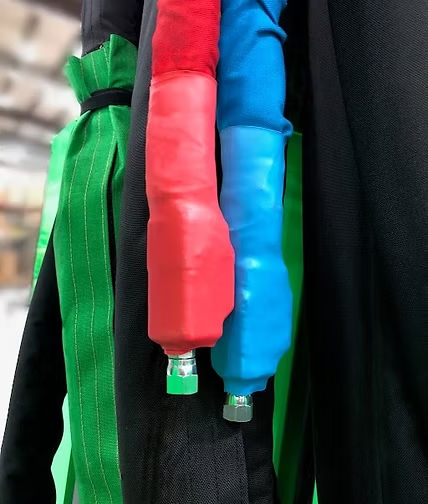
Internally Heated Spray Foam Hose: Why Independent 50-Foot Heating Sections Matter
Akurate Dynamics’ HD Hose Series combines internal hose heating with independent heating in each 50-foot section. This allows individual sections to respond to the different environmental conditions encountered along a spray foam hose run.
For contractors comparing heated spray foam hoses, the heating element’s location is only part of the story. How the system manages heat along the hose matters, too.
An easy way to understand the difference? Think about Christmas lights.
What Christmas Lights Can Teach Us About Hose Design
Remember troubleshooting old-fashioned Christmas lights? Some older series-wired strands could go dark when one bulb failed. You worked your way through the strand to find the problem.
Newer designs introduced ways to keep more of the display operating independently. The lesson was straightforward: how the sections are connected and managed affects the entire system.
The analogy applies to spray foam hose heating as well. A connected hose run can encounter several different environments. Treating the entire run as one heating zone gives the system fewer ways to respond to those differences.
Akurate’s approach gives each 50-foot section its own heating response.
The Christmas-light comparison illustrates section independence. It does not mean a contractor should continue spraying with a damaged hose or a heating fault.
External vs. Internal Spray Foam Hose Heating
Externally heated spray foam hose places the heating element outside the chemical hose. Heat must travel through the hose wall to reach the material.
Internally heated hose places the heating element inside the hose, in contact with the material. Akurate Dynamics uses this approach in its HD Hose Series.
Other equipment manufacturers also offer internally heated hose. That makes it important to look beyond the words “internally heated.”
Those words tell you where the heating element is located. They do not tell you whether each section along the hose can be heated independently.
A 50-Foot Hose Is Not Necessarily an Independent Heating Zone
Hose length and heating control are different specifications.
A hose may be sold in 50-foot sections, yet those connected sections may operate together as one heating zone. Physical connections between sections do not automatically provide independent temperature control.
Akurate Dynamics’ HD Hose Series uses an internal heating element in each 50-foot section, with independent section heating. Its Deltalite system also provides separate A-side and B-side temperature control.
That gives contractors two distinct capabilities:
Independent A-side and B-side heat to address the temperature needs of the two chemicals.
Independent section heating to address different conditions along the hose run.
One Hose Run. Several Different Environments.
Picture 200 feet of spray foam hose on a jobsite.
The first section is inside a warm rig. The next lies on cold concrete. Another crosses an area exposed to wind. The final section enters a heated building.
The sections are connected, but their heating needs can differ.
A conventional system that controls the connected run as one heating zone applies a common heating response across those sections. Depending on the design, control may rely on a temperature sensor at a particular location or another method of estimating hose temperature.
Akurate’s segmented design allows each 50-foot section to respond independently. A colder section can receive a different heating response from a warmer section.
The goal is to manage the conditions along the hose, all the way toward the gun.
Comparing Heated Spray Foam Hose Designs
Design feature | Conventional external heat | Other internal heat designs | Akurate Dynamics HD Hose Series |
|---|---|---|---|
Heating element location | Outside the chemical hose | Inside the chemical hose | Inside the chemical hose |
Heat delivery | Through the hose wall | Direct contact with the material | Direct contact with the material |
Independent A/B temperature control | Depends on the system | Depends on the system | Yes |
Independent heating of each 50-foot section | No | No | Yes |
The comparison is about control architecture. Internal heat, separate A/B heat, and independent section heating are three different features. Contractors should ask about each one.
Why Independent Section Heating Matters
Spray foam is manufactured at the jobsite. The hose carries the two materials through changing conditions before they meet at the gun.
Independent section heating gives the equipment a more specific way to manage that journey. Instead of assuming every section needs the same heating response, the system can address conditions section by section.
Temperature management is one part of proper spray foam processing. Contractors still need to follow the chemical manufacturer’s processing requirements and manage ratio, pressure, mixing, and application conditions.
For Akurate Dynamics, the hose is an active part of that processing system. Its design should account for what happens between the rig and the gun.
Questions to Ask Before Choosing Heated Spray Foam Hose
Before comparing price or hose length, ask:
Is the heating element internal or external?
Can A-side and B-side temperatures be controlled independently?
Does each connected section have independent heating control?
How does the system respond when sections encounter different environments?
What temperature information does the operator receive?
These questions reveal more than the label “heated hose” ever will.
Frequently Asked Questions
What is internally heated spray foam hose?
Internally heated spray foam hose places the heating element inside the chemical hose, where it contacts the material. External heating places the element outside the chemical hose and transfers heat through the hose wall.
What is segmented hose heating?
Segmented hose heating divides the hose run into sections that receive independent heating responses. Akurate Dynamics’ HD Hose Series uses independently heated 50-foot sections.
Does a hose sold in 50-foot lengths have independent section heating?
Not necessarily. Section length describes the physical hose. Independent section heating describes how the heating system operates. Contractors should verify both specifications.
Is independent A/B heat the same as independent section heat?
No. Independent A/B heat manages the two chemical sides separately. Independent section heat manages different locations along the hose run. Akurate’s design provides both.
How does the Christmas-light analogy explain segmented hose heating?
The analogy illustrates the value of managing sections independently instead of treating an entire connected run as one unit. In hose heating, that independence allows sections to respond to different environmental conditions.
Internal heat answers where the heat comes from. Independent section heating answers how it responds along the run.
Akurate Dynamics’ HD Hose Series was designed to address both.
Learn more about the HD Hose Series and Deltalite Controller at AkurateDynamics.
Subscribe For Industrial News And Insights
Latest Article